Fifteen-Minute Intervals: The Home Portrait Hiding in Your Utility Bill
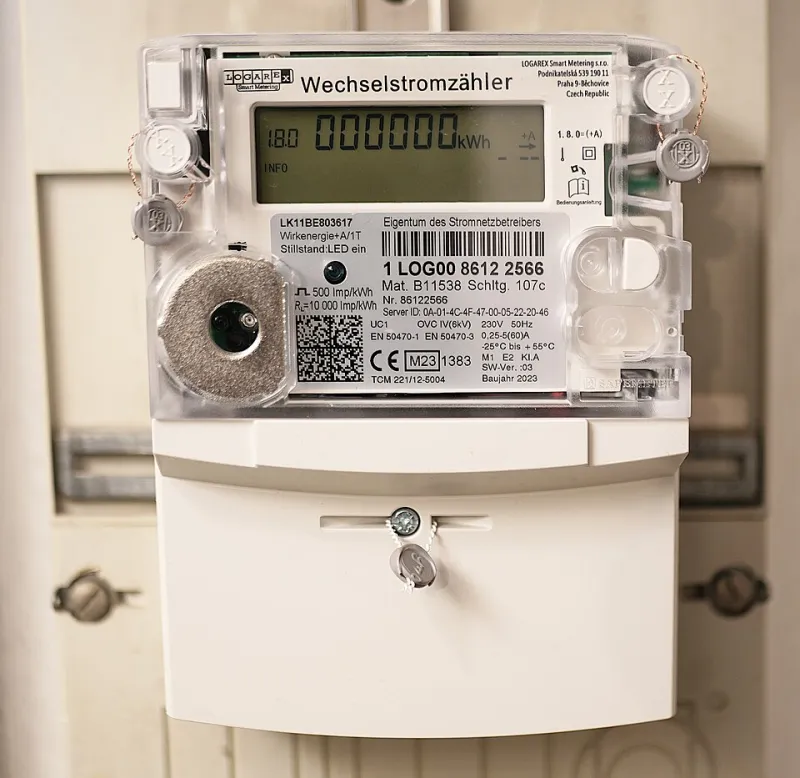
Photo: RobbieIanMorrison, CC BY 4.0, via Wikimedia Commons
The smart meter bolted to the side of your house doesn't just tally usage once a month. In most of the United States, it records consumption in fifteen-minute — and in some territories, five-minute — intervals, transmitting that stream back to the utility around the clock. Utilities describe it as the backbone of grid modernization. Privacy researchers describe it as something else: a behavioral diary written in electricity.
The Signature of an Empty House
Load data is remarkably legible once you know what to look for. A home's baseline draw — the constant hum of a refrigerator, a router, a standby-laden entertainment center — forms a fingerprint. Deviations from that baseline tell a story. A spike at 6:45 a.m. followed by a lull suggests a coffee maker and a departure. A sustained overnight plateau where none existed before may indicate a new tenant, a shift worker, or an elder moving in.
Academic work has repeatedly shown that appliance-level activity can be disaggregated from whole-home interval data using techniques known as non-intrusive load monitoring. Heat pumps, electric vehicles, well pumps, and even gaming consoles each carry a distinctive electrical signature. In one frequently cited study, researchers correctly identified whether a home was occupied on a given day with accuracy approaching 90 percent using consumption data alone.
That matters because occupancy is exactly the kind of fact that other parties want to know. Insurers pricing or contesting a homeowner's policy. Landlords verifying lease compliance. Advertisers timing their pitches. Process servers confirming someone is home. None of these parties needs to peer through a window when the meter is already talking.
Who Gets to See the Stream
The legal architecture governing this data in the US is a patchwork. Federal privacy statutes largely don't reach it — the Energy Policy Act of 2005 encouraged smart meter deployment but said little about the resulting data. The FTC's framework treats utility customer information case by case. That leaves state utility commissions and, more recently, comprehensive privacy statutes like the California Consumer Privacy Act and its successor, the CPRA, to fill the gap.
California explicitly classifies energy usage data as personal information under the CCPA, meaning residents can request access to it, ask who it's been shared with, and in many cases demand deletion. Texas requires customer consent before a utility releases detailed usage data to third parties, with a separate tier for sharing with retail electric providers. Illinois, Colorado, and a handful of others have adopted similar consent-based frameworks through their commissions. In much of the country, however, the default is disclosure under the utility's tariff terms — the dense rate schedule almost nobody reads.
The third-party ecosystem has grown accordingly. Utilities routinely share aggregated or anonymized data with analytics firms for grid planning. Some partner directly with marketing platforms for energy-efficiency campaigns. Home insurance programs have experimented with usage-based discounts that require real-time meter access — a trade of privacy for premium credits that sounds benign until a claim dispute arises and the same data becomes evidence.
What You Can Ask For
Consumers are not without leverage, though exercising it requires knowing the right counterparty. Requests go to the utility first, not the state.
- Request your own interval data. Under CCPA and most state open-records-style utility rules, you can obtain the same granular record the company keeps. Seeing it is the first step to understanding what it exposes.
- Ask for the disclosure list. Several states require utilities to identify third parties receiving customer data. Even where not required, commissions often accept informal inquiries.
- Opt out where programs allow it. Many utilities offer opt-outs from optional data-sharing programs, including the efficiency-report comparisons printed on bills. These are separate from the meter itself, which in most jurisdictions cannot be removed.
- Contest the inferences. If an insurer or landlord uses usage-derived conclusions against you, document it. Several state statutes prohibit adverse decisions based on data obtained without disclosed consent.
For readers outside comprehensive-privacy states, the calculus is bleaker. The practical mitigations are behavioral rather than legal: be aware that optional sharing programs are opt-in by design, and treat any "smart home energy report" partnership as a data-sharing decision, not a convenience feature.
The Coming Squeeze
Two trends are converging on this data. Electrification — EVs, heat pumps, induction ranges — is making household load profiles richer and more identifying, not less. And the analytics industry has matured to the point where occupancy inference is a product, not a research project. The fifteen-minute interval that seemed abstract a decade ago is now a saleable commodity.
The utilities' position is not entirely unreasonable: granular data genuinely enables outage response, demand management, and faster interconnection of solar. But the privacy defaults were set by rate cases, not by the people whose homes the data describes. Until legislatures catch up, the burden of understanding what the meter says — and to whom it speaks — rests with the household. The meter, unlike the people inside, never stops reporting.